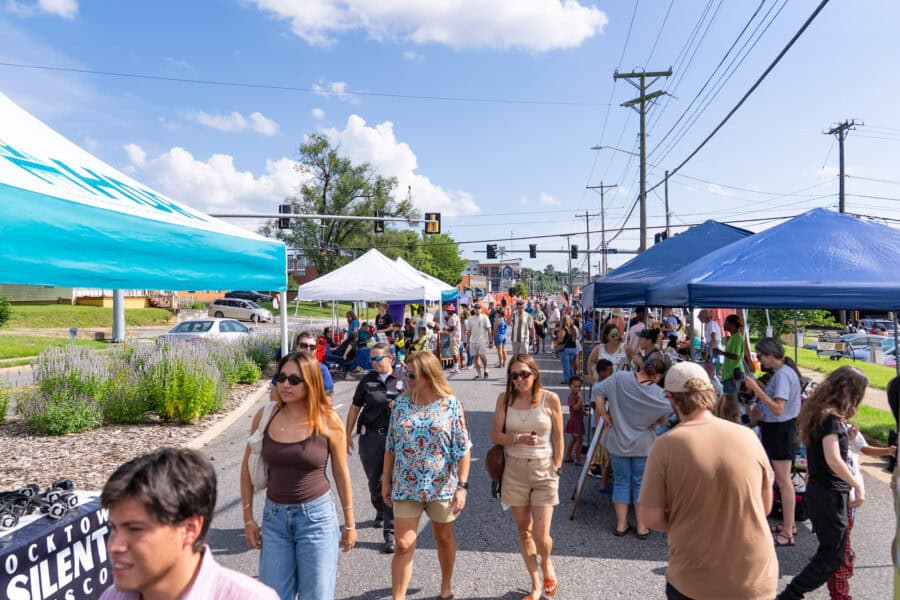
At the Shenandoah Valley Bike-Walk Summit in Staunton on October 23, 2026, author and Rutgers professor Charles T. Brown told Valley planners, advocates, and local leaders to start with where people need to go, fit the street to the place, and bring the people most affected into the design process.
TL;DR · Key Takeaways
On Friday, October 23, 2026, about 75 people gathered at Hotel 24 in Staunton for the Shenandoah Valley Bike-Walk Summit, a day on making walking and biking safer across Staunton, Augusta County, and the wider Shenandoah Valley. Keynote speaker Charles T. Brown, author of Arrested Mobility, offered a practical playbook: connect everyday destinations, make the road fit the place, make the dangerous part of the trip safer, and build the political support to finish the job. He called Staunton’s month-long Beverley Street pop-up a success worth repeating, and closed with a challenge: a seat at the table is not the same as a say in how the table is built.

In Clifton Forge, residents of an apartment complex had no safe way to walk to the grocery store. The route was a highway shoulder. A temporary pop-up project created a protected path because local residents worked with local officials and a state engineer to change the design of a state road.
Charles Brown held up that project as proof of his central point at the summit: the fixes people say are impossible are often one conversation with a state engineer and one good drone photo away.
What was the Shenandoah Valley Bike-Walk Summit?
The Shenandoah Valley Bike-Walk Summit brought together local government staff, planners, advocates, health and youth organizations, and residents from across the Valley at Hotel 24 in Staunton on Friday, October 23, 2026. The Alliance for the Shenandoah Valley and the Shenandoah Valley Bicycle Coalition were among the organizing partners.
A screening of the film The Street Project at Visualite in Staunton on Thursday evening, October 22, set the stage with a discussion about what the Valley’s streets could look like.
Friday’s program ran from breakfast and opening remarks through Brown’s keynote, a panel of local quick-build street projects from Woodstock, Clifton Forge, and Staunton, a facilitated lunch discussion, and a walking tour of the Beverley Street area.

Who is Charles Brown?
Charles T. Brown is an adjunct professor at the Edward J. Bloustein School of Planning and Public Policy at Rutgers University, the founder of the consulting firm Horizon 54, and the author of Arrested Mobility: Overcoming the Threat to Black Movement (Island Press), which examines how policy, planning, and policing limit who gets to move freely through public space. His keynote focused on what Valley communities can do now, rather than on his book.
Part one: Make everyday destinations easier to reach
Brown organized his talk around one question: how do you make everyday destinations easier to reach? His answer came in steps that any town, county, or advocacy group can start on.
Start where people need to go. Begin with the life someone is trying to live, whether in a village center, a suburb, or on a rural road, and work to put housing and daily destinations closer together. Transportation and land-use plans must be written together.
Fix the short trip the system has made difficult. Brown pointed to the trip to a grocery store, a school, or a park that residents can’t make safely on foot or by bike.
Choose useful connections over scattered segments. “There’s nothing more debilitating,” he said, “than being on a sidewalk or in a bike lane and it abruptly stops.” A route needs to lead somewhere that matters, and walking and biking need to connect to transit.
Make the road fit the place. A rural road should not look like an urban street, and a bike lane on every street is neither plausible nor necessary. Where a highway becomes a town’s main street, Brown said, it should start to behave like one, with context-sensitive design that protects local businesses and provides everyone with safer access. Rural roads need rural solutions, and Clifton Forge showed what one looks like.
Give people somewhere to walk outside the travel lane. New destinations need sidewalks that reach the front door, not just a parking lot.
Part two: Make the dangerous part of the trip safer
“A single dangerous crossing can put an entire journey out of reach,” Brown said. His list for the hard parts of a route:
- Design slower speeds into the street. He argued that the people who design, police, and report on streets mostly drive, so streets default to driver convenience.
- Consider a road diet (right-sizing) where lanes provide more space than traffic needs, in rural, suburban, and urban settings alike.
- Match bike protection to traffic conditions. Some streets need protected lanes or cycle tracks. Others need less.
- Give pedestrians the crossing treatment the road demands, including places to pause on wide streets, and make crossings reflect the neighborhood they serve.
- Design beyond nine to five. People walk at night because they have no other choice, he said, and streets should be safe for them.
- Fix the bridge or bottleneck that breaks the network.
- Plan for maintenance from day one. “Without it, you’re just playing games,” he said of any project that celebrates an opening and then lets the route decay.
His reminder for anyone documenting this work: take a drone photo. A view from above lets decision-makers see the context and picture themselves there.
Part three: Safe routes for children come first
“If children and older adults are not safe, your community is not safe,” Brown said, and he pressed the Valley to look past traffic safety to personal safety as well. Children deserve company on the walk, and streets should be designed with both kinds of safety in mind.
In the Q&A, an audience member asked how to get more kids safely to school on foot or by bike. Brown’s practical answers:
- Ask the children which routes they already take, then make those routes permanent and test them with data.
- Start walk-in school buses, where adults walk a route and pick up students along the way.
- Fund crossing guards, who he called front-line people who care and are trained to protect children.
- Campaign for “20 is Plenty” speed limits near schools.
- Build traffic gardens, small practice streets in underused parking lots where kids learn to ride safely.
When an audience member raised worries about young e-bike riders ignoring stop signs, Brown’s answer was to educate rather than ban: teach the rules at school, pair the new mode with training, and keep pressure on driver behavior, since a car is what usually strikes a child. A question from another attendee about horse-and-buggy collisions on rural roads earned his agreement that they deserve more attention in the Valley.
Part four: Build the support to deliver
Brown spent the last third of his talk on the part he said stops good projects: politics.
- Start with a problem people recognize. “Agree on the problem before debating the treatment,” he said, and let the people closest to the problem shape the solution.
- Find out what the opposition is actually opposing.
- Bring people with authority into the work early. In one New Jersey town, police resisted enforcing the state’s pedestrian-crossing law until Brown’s team took officers out to the crosswalk, day and night. Watching drivers fail to stop for an older woman, a child, and, finally, an out-of-uniform officer changed their minds.
- Build a Coalition to shape the proposal, including faith communities, whom he said are rarely at the table in transportation work.
- Measure with the community. Asked how to address resistance to trial projects, Brown said to agree on success measures with residents before building, collect before-and-after data, and track community measures such as comfort, convenience, and trust alongside engineering metrics. “Without data, all you have is an opinion.”
Beverley Street: Staunton’s pop-up, in context
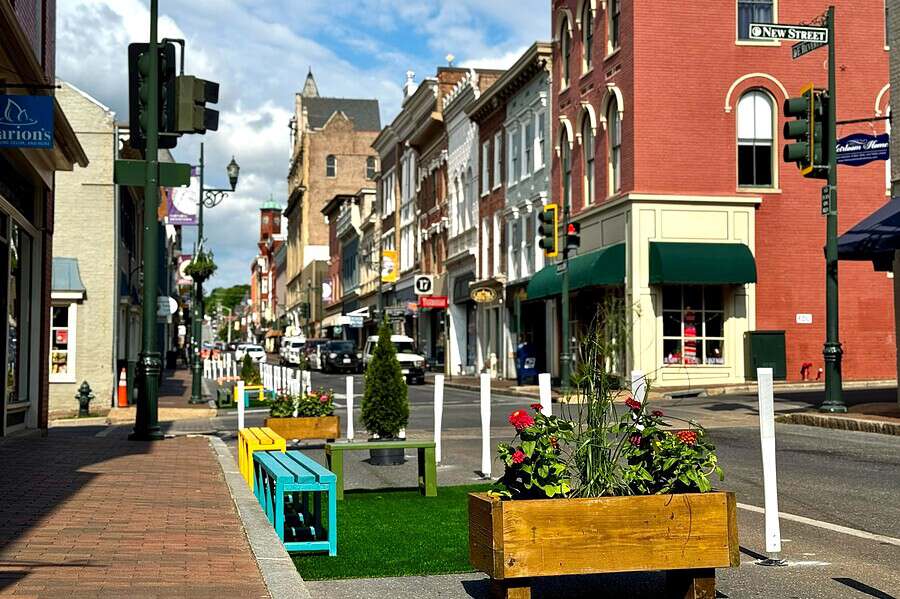
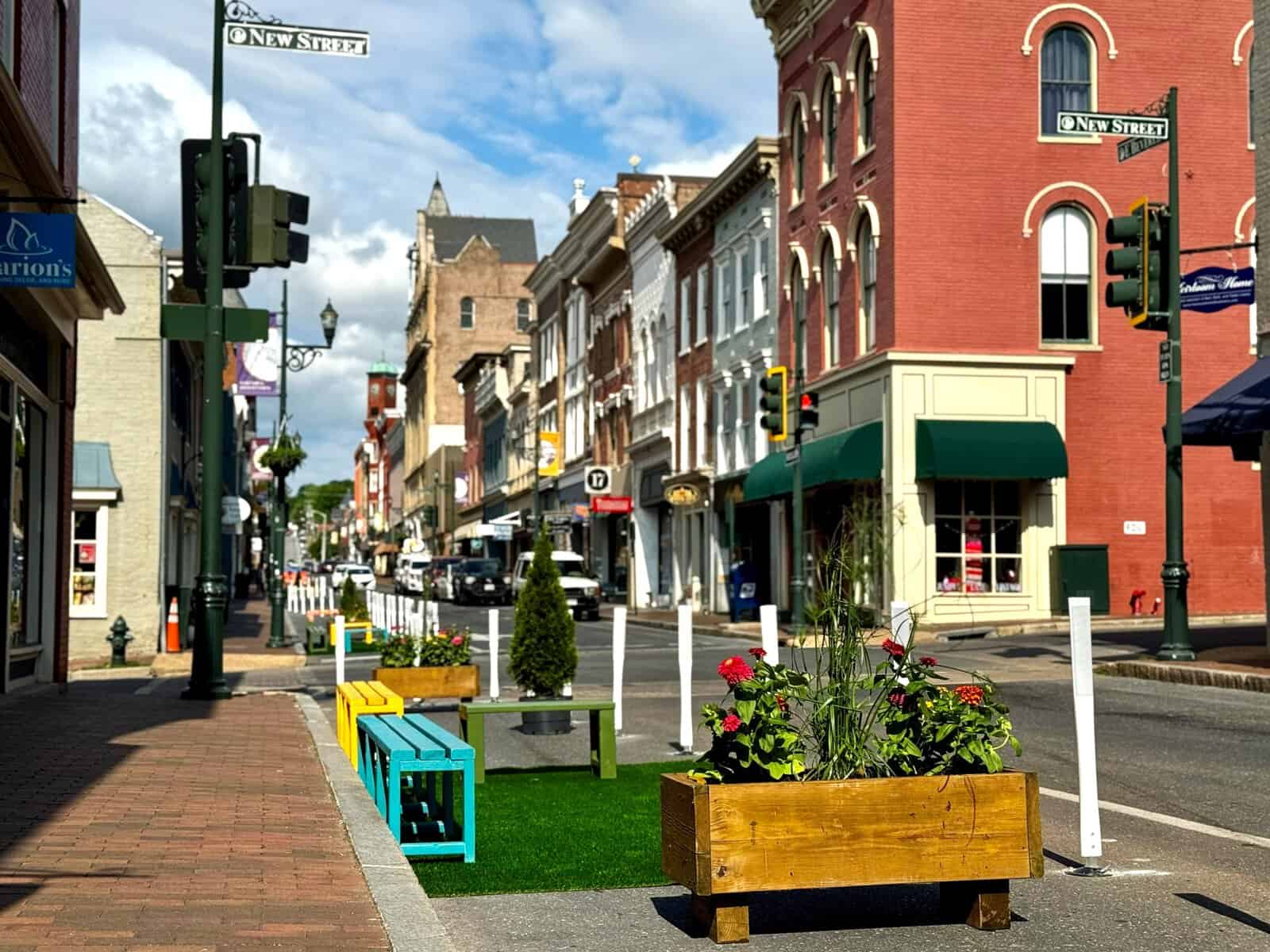
Brown singled out Staunton’s Beverley Street demonstration project, a month-long pop-up in the heart of downtown, and urged the people behind it to try again. Here is what the project was.
What changed on the street
From June 1 to June 30, 2026, the City of Staunton, working with the Central Shenandoah Planning District Commission, closed the right-hand travel lane on two blocks of Beverley Street between Augusta Street and Market Street, dedicating that space to people on foot. White flexible posts separated the pedestrian space from traffic. Colorful (locally produced) benches, planter boxes, patches of turf, and public art made it feel like a place to stay. A loading zone stayed open on each block for deliveries, and no existing parking spaces were removed. QR code signs linked passersby to the project page and survey.
Why Staunton tried it
The pop-up was a low-cost preview of permanent changes. The city has a federally supported project planned for 2027 to add safety improvements at nine downtown intersections, including new pedestrian signals, higher-visibility crosswalks, and improved corner ramps. The demonstration itself cost about $6,000 and was funded by a Virginia Department of Health walkability grant. The city called it a “try before we buy” test: removable materials, and no funded plan yet to make the pedestrian space permanent.
The ask started with residents. A pre-demonstration survey conducted from April 11 to May 31, 2026, received 426 responses. Sixty percent of respondents walk on Beverley Street weekly or daily. Their top requests were planters and greenery (61 percent), seating (53 percent), public art (42 percent), and more room to walk (41 percent). Some respondents also raised concerns about deliveries and loading for downtown businesses. The Coalition shared the survey in a June post so more Valley residents could weigh in.
What people said afterward
Reaction was divided. Coverage of the post-demonstration survey described a strong response, around 1,000 people, with views split depending on whether respondents had stopped to use the space.
That split is exactly what Brown meant when he said a project that earns a strong reaction needs a strong response. In his view, the project was a success by its own metrics. In that it slowed traffic and provided additional space for people to walk and sit.
The lesson he drew is the one he left the room with: define success with residents before building, measure before and after, and do not let a loud minority decide the question alone. Then try again.
See it for yourself: photos and video
- The project page from the Central Shenandoah Planning District Commission has photos of the installation, a project map, and the survey results.
- WHSV’s report from the first weeks of the pop-up includes a video and interviews with city staff and a nearby business owner.
- View a video of the Project from the Bicycle Coalition

The closing challenge: who built the table?
Brown ended on inclusion. Inviting people to the room is not enough, he said. “Having a seat is not the same as having a say,” and a say is not the same as the power to shape what happens next. The question he left the room with was what the table would look like if the people so often left out of planning had helped design it in the first place.
“I’m here not because I’ve received invitations. I’m here because I’ve built tables.”
What this means for the Valley
Several of Brown’s examples already have Valley counterparts:
- Quick-build projects that prove the idea. The Woodstock, Clifton Forge, and Staunton projects showed how paint, flexible posts, benches, and planters can test a street before the budget exists to rebuild it.
- Walking and biking that connect. The trails and active-transportation work across the Valley only matter if people can reach them on foot or by bike.
How to get involved
Every project Brown described started with someone who showed up. Pick one place near you where a short trip is hard, take a photo, and tell your town or county staff what you see. And to keep the Shenandoah Valley Bicycle Coalition building trails and advocating for safer walking and biking across Augusta, Rockingham, and Shenandoah counties, a gift today helps.
Kyle Lawrence is Executive Director of the Shenandoah Valley Bicycle Coalition. The Shenandoah Valley Bicycle Coalition builds and enhances trails on public lands, advocates for safer walking and biking, and connects communities across the Shenandoah Valley region. A 501(c)(3) nonprofit. EIN: 34-2016415. Learn more about the Coalition.