Editor’s note: Why is a bicycle coalition writing about trains? Because rail and bikes solve the same problem — getting around the Valley without a car — and they work together: trains handle the long haul, bikes and trails handle the “last mile” on either end (Amtrak trains carry bikes onboard, too). Advocating for passenger rail is part of the Coalition’s broader mission of active transportation across the Valley, not a departure from it. It also does not conflict with our support for the Shenandoah Rail Trail — the two are not in competition.
Blue Ridge Rail’s proposal does not use the old Chesapeake & Western corridor that would become the Rail Trail (Broadway to Front Royal). It relies on two separate corridors that are already active, operating freight lines today: the Norfolk Southern Shenandoah Line and the Buckingham Branch/Commonwealth Corridor. By contrast, VDOT’s own December 2025 assessment puts the cost of restoring the Rail Trail corridor’s tracks at roughly $315 million (part of a $697 million combined rail-with-trail estimate) — before any passenger-specific investment — versus about $187 million to convert that corridor to a trail-only. That is why the Coalition sees the Rail Trail’s future as a trail and sees Blue Ridge Rail’s already operating freight corridors as the realistic path to bringing passenger trains back to the Valley.
A guest post from Blue Ridge Rail on the case for bringing passenger train service back to the Shenandoah Valley.
In this context, we present A Case for Passenger Rail in the Shenandoah Valley, highlighting the importance of integrating rail services into our transportation strategy.
By Gabriel Morey, Blue Ridge Rail
TL;DR — KEY TAKEAWAYS
Blue Ridge Rail is asking Virginia to add the Shenandoah Valley as a destination in its 2026 State Rail Plan — the first real step toward bringing passenger train service back to Harrisonburg and the Valley. It would not interfere with the Shenandoah Rail Trail. Add your voice: sign the petition below by September 21 so comments can be compiled ahead of the state’s September 30 deadline.
Before my family moved to Harrisonburg in 1999, we lived in Carbondale, Illinois. Although I was only five when we moved, I remember visiting the city recycling center with my dad to watch the Amtrak trains go by. Although we never rode the Illini, Saluki, or City of New Orleans, I remember believing that every town in America had passenger trains.
Then we moved to Harrisonburg, and there were no trains. There were many other things to love, but getting to and from Harrisonburg was only possible by getting on I-81 and fighting traffic. Today, we are lucky to have the Virginia Breeze, but travel by bus is still subject to interstate delays, infrequent service, and limits as to what you can bring on board.
Blue Ridge Rail wants to change that. We envision a future where residents can travel by train to places like Richmond, Hampton Roads, Roanoke, and DC. Such service would expand freedom of mobility for residents, reduce emissions, and provide a new way for students and visitors to explore the Valley.
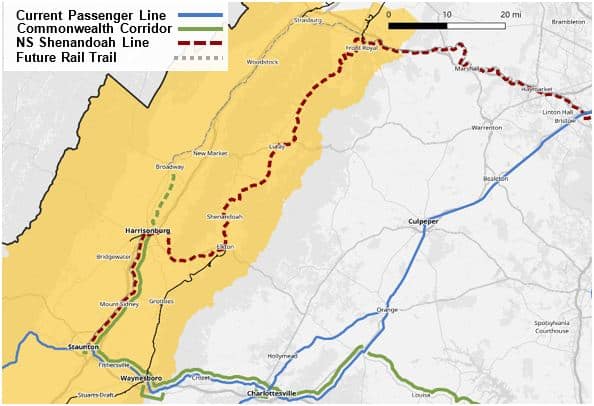
Before I go further: Blue Ridge Rail is committed to non-interference with the Shenandoah Rail Trail. We are not vying for the old Chesapeake and Western right-of-way from Broadway to Front Royal. Instead, there are two other existing rail corridors into the Valley that could host passenger rail (see Figure 1 below).
One is a north-south line from Front Royal to Harrisonburg/Staunton via Page County (“NS Shenandoah Line”). This line would provide direct service to Northern VA and DC. The second line is the east-west Buckingham Branch line that runs from Clifton Forge, through Staunton, to Doswell. This line, labeled “Commonwealth Corridor,” would provide an east-west connection from Harrisonburg/Staunton to Charlottesville, Richmond, and Hampton Roads. Passengers could make connections to DC-bound trains in Charlottesville.
But why trains? Virginia currently supports 8 daily round trips between Roanoke, Richmond, Hampton Roads, and Norfolk. By 2030, the state plans to increase that number to 13 daily round trips, or 26 trains. To do this, Virginia has purchased over 412 miles of right-of-way. These purchases include the entirety of the Buckingham Branch line that runs from Clifton Forge, through Staunton and Charlottesville, and ends at Doswell, just north of Richmond. It’s this state-owned line that the “Commonwealth Corridor” route would use. As Virginia has invested, ridership has boomed: FY25 ridership was up 57% on Virginia Amtrak compared to FY19. And, as shown in Figure 2, Virginia is not done expanding. Planned expansions include Christiansburg, Bristol, the Roanoke-Hampton Roads Commonwealth Corridor, and the Richmond-Raleigh higher-speed corridor.
The 380,000 people living in the Shenandoah Valley are cut out of this network. The nearest train is the Cardinal, in Staunton. But with a three-day-a-week schedule and a 55% on-time-performance rate (delays are hard to avoid on a roughly 900-mile route on freight-owned tracks), the Cardinal is not convenient or reliable.
A regional connection to either DC or Richmond/Hampton Roads would bridge this gap. A Virginia Amtrak service, especially if on the state-owned Commonwealth Corridor, would not get bogged down by the freight train delays that make Amtrak’s long-distance routes unreliable. Running 100-200 miles in length, such a line would hit the “golden distance” for rail: too short to fly, too long to drive. Importantly, there would be no tolls, no traffic jams, no tailgating, and no collisions on the train. Instead, passengers could relax, eat, drink, stretch, read, or sleep.
The Valley Is Primed for Rail
Already walkable, bikeable, and transit-connected. Half of the Valley’s residents live in a city or town, most of which have dense, walkable downtowns. The two largest cities, Harrisonburg and Staunton, have local transit networks. And thanks to tireless work from the Coalition and other organizations, there are solid biking and walking connections. This largely solves the “final mile” problem of getting to and from stations in many of the Valley’s population centers.
31,000 ready-made riders. The 31,000 college students in the Valley are a ready-made market. College students disproportionately ride trains; of Virginia’s Amtrak ridership in FY25, 47% came from college towns (note that analysis does not include Richmond). Train service enables students to live car-free, reducing traffic and lowering emissions in town.
Comfortable and easy. Onboard the train, you can eat, drink, and use the bathroom whenever. Kids can wiggle and walk the aisle. Everyone can relax and enjoy the scenery. Rail also offers more options than buses or airplanes on what passengers can bring onboard: Amtrak allows bikes, strollers, skis, fishing poles, and more. Imagine loading your bike on the train in Harrisonburg, relaxing the whole ride to Richmond, and then biking the Capital Trail. It’s possible on the train!
Better for the planet. Rail provides an environmentally sustainable way to travel. Rail – even diesel rail – is more energy efficient per passenger-mile than cars. Future electrification would make it even cleaner. Trains also require far less land to move people than highways, reduce the need for land-hungry parking lots, and encourage development to center in existing urban areas.
How We Get There
So how are we doing this? The first step is to convince the Department of Rail and Public Transit to add the Valley as a destination in its 2026 State Rail Plan. The state updates this plan every four years. With the state making large investments, this is a once-in-a-generation chance to bring rail to the Valley. Comments close on September 30, but we are over halfway to our goal of 1,000 comments in support of our petition. After we get in the rail plan, we’ll continue to build political support around the Valley, with an eye toward getting the General Assembly to adopt legislation in 2028 requesting a formal study of service by DRPT.
This will not be a fast process, but it is worthwhile. Numerous other cities – Culpeper, Charlottesville, Williamsburg, Lynchburg – have rail service. The Valley could, too. So please, check us out at blueridgerail.org, sign the petition by September 21 (so we can compile comments by the 9/30 deadline), and share it with your friends and family.
I hope to see you on the train in the future!
ABOUT THE AUTHOR
Gabriel grew up in Harrisonburg, Virginia, where he learned to be independent and free by biking around town, and learned the beauty of biking the county from the Coalition. He currently works for the Washington Metropolitan Area Transit Authority, where he manages the Clear Lanes program for the Metrobus. He has a master’s in Public Administration. He currently lives in Alexandria, Virginia with his wife and daughter.